Next scheduled meeting
September 15–16, 2026
Meeting dates only; release time is not asserted here.
12-meeting index
Date · action/range · vote · official records
What changed across this 12-meeting window
The linked records move from 2025 reductions to the 3.50%–3.75% range retained in the June and July 2026 statements.
Records: july-2026 · june-2026 · december-2025 · june-2025 · march-2025
The linked source records preserve the Committee's balance-sheet implementation language across the window; the public archive does not add an interpretation beyond those records.
Records: july-2026 · june-2026 · december-2025 · june-2025 · march-2025
The April statement described low job gains, while the June and July statements described job gains keeping pace with the workforce and little change in unemployment.
Records: july-2026 · june-2026 · april-2026 · march-2025
The linked 2026 statements describe elevated inflation and uncertainty, with April, June, and July noting energy or Middle East context in their stated conditions.
Records: july-2026 · june-2026 · april-2026 · march-2025
The June record shows a 12–0 vote; July records a 9–3 decision with three dissents favoring a 25-basis-point increase.
Records: july-2026 · june-2026 · april-2026 · march-2025
Market context
Pricing status: not_captured
A sealed point-in-time market-price or consensus snapshot is unavailable, so no probability or path claim is shown.
Transmission monitor
These are transmission channels commonly monitored after policy communications; no directional market outcome is asserted.
July 28–29, 2026
Action: Maintained 3.50%–3.75%
Vote: The decision was 9–3. Three dissenters preferred a 25-basis-point increase.
Statement · Minutes pending · SEP unavailable
SEP: No SEP was published at this meeting.
What changed
- The vote recorded three dissents favoring a 25-basis-point increase.
- The statement cited elevated uncertainty partly related to the Middle East.
What held
- The Committee maintained the 3.50%–3.75% target range.
- The statement continued to describe inflation as elevated.
Policy action and vote
The Committee maintained the 3.50%–3.75% target range in a 9–3 decision.
Growth and labor
The statement described solid activity, strong productivity and capital investment, and job gains keeping pace with workforce growth.
Inflation and energy
The statement described elevated inflation tied to supply shocks and energy developments.
Uncertainty
The statement said uncertainty remained elevated, partly related to the Middle East.
Statement assessment
- The statement retained the 3.50%–3.75% target range in a 9–3 decision, with three dissenters preferring a 25-basis-point increase.
- It characterized activity and investment as solid and described job gains as keeping pace with workforce growth while unemployment changed little.
- It described inflation as elevated amid supply shocks and energy developments, with Middle East uncertainty elevated.
Minutes assessment
- Minutes are unavailable for the July 28–29 meeting; no minutes-based claims are presented.
The release provides a descriptive snapshot of the Committee’s stated conditions and vote; it does not establish a subsequent policy path.
June 16–17, 2026
Action: Maintained 3.50%–3.75%
Vote: The decision was 12–0.
What changed
- The documented vote was unanimous at 12–0.
- Published minutes separately recorded intermeeting market context.
What held
- The Committee maintained the 3.50%–3.75% target range.
- The statement described activity as solid and uncertainty as elevated.
Policy action and vote
The Committee maintained the 3.50%–3.75% target range in a unanimous 12–0 decision.
Growth and labor
The statement described solid activity, productivity, capital investment, and labor conditions keeping pace with workforce growth.
Inflation and energy
The statement described elevated inflation through energy.
Labor conditions
Job gains kept pace with the workforce, while the unemployment rate changed little.
Statement assessment
- The statement held the 3.50%–3.75% range in a unanimous 12–0 decision.
- It described solid activity, productivity, and capital investment alongside labor conditions keeping pace with workforce growth.
- It described elevated inflation through energy and elevated uncertainty without providing a policy projection.
Minutes assessment
- The minutes described higher expected policy rates, Treasury yields, the dollar, and equities during the intermeeting period.
- They also described lower near-term inflation compensation after optimistic conflict developments; this minutes observation is distinct from the statement.
The statement and minutes offer separate, dated descriptions of conditions and intermeeting market context, not a prediction of subsequent decisions.
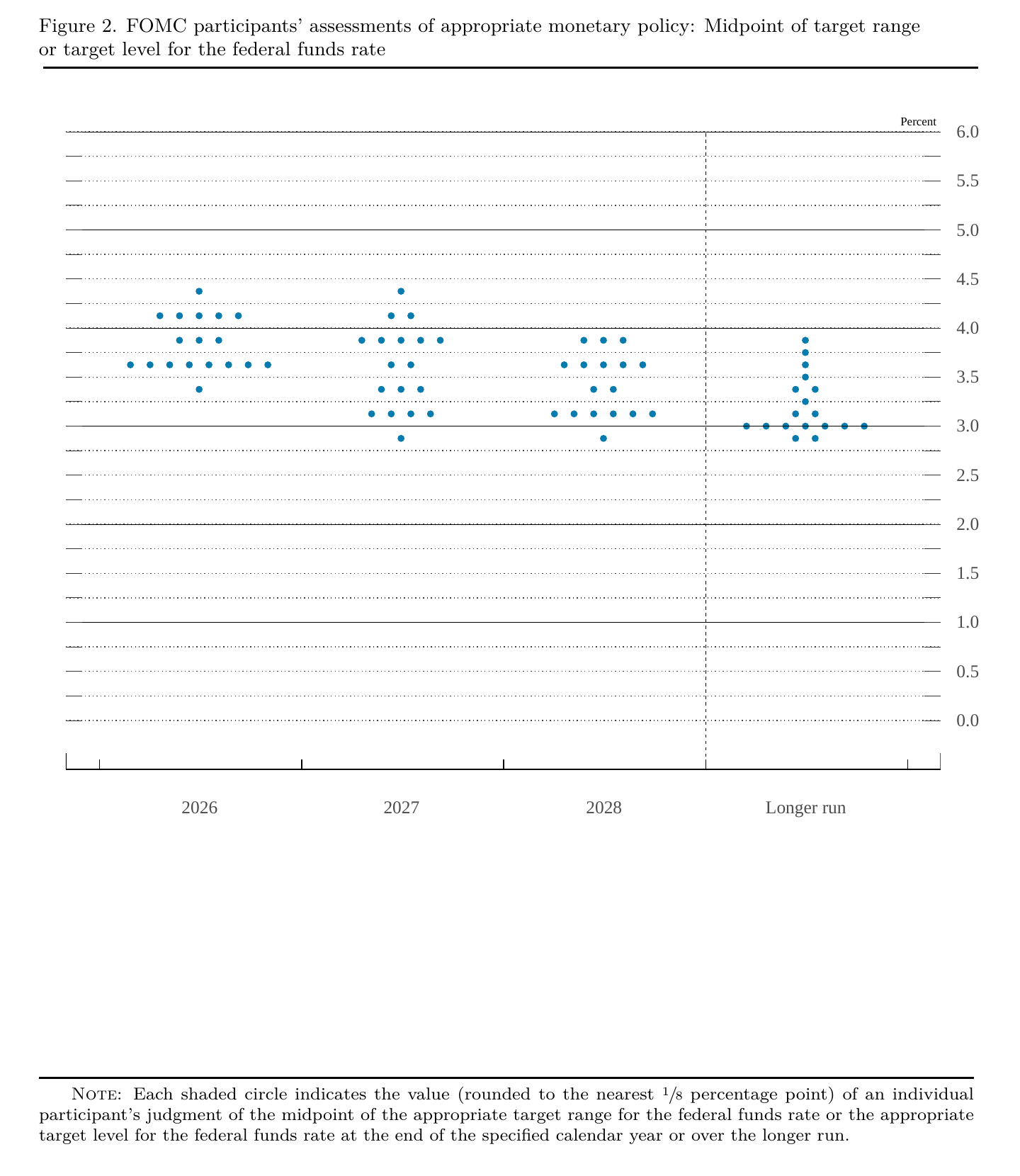
Axes: x-axis 2026, 2027, 2028, Longer run; y-axis 0.0–6.0, step 0.5.
Official June 2026 SEP HTML · Official source PDF (page 4)
Source PDF SHA-256: a517887623520922a782e0cd01fb38d4469bed951f63d2588efb99f72deddde3 · local Figure 2 crop SHA-256: fe20f4d35f5964cd700f3f8ada7ef05dd1bcd4ee790706949ad2eb1d55cda14a.
This figure presents individual participant assessments, not a Committee forecast, promise, probability distribution, or investment recommendation.
April 28–29, 2026
Action: Maintained 3.50%–3.75%
Vote: Miran preferred a 25-basis-point cut. Hammack, Kashkari, and Logan supported holding the range but objected to including an easing bias.
Statement · Minutes · SEP unavailable
SEP: No SEP was published at this meeting.
What changed
- Miran preferred a 25-basis-point cut.
- Hammack, Kashkari, and Logan supported holding the range but objected to including an easing bias.
What held
- The Committee maintained the 3.50%–3.75% target range.
- The statement said it would carefully assess incoming data, the evolving outlook, and the balance of risks.
Policy action and vote
The Committee maintained the 3.50%–3.75% target range; Miran preferred a 25-basis-point cut, while Hammack, Kashkari, and Logan objected to including an easing bias.
Growth and labor
The statement said job gains remained low.
Inflation and energy
The statement described inflation in connection with global-energy-price developments.
Uncertainty
The statement characterized Middle East uncertainty as high.
Statement assessment
- The statement said job gains remained low and described inflation in connection with global-energy-price developments.
- It characterized Middle East uncertainty as high and said the Committee would carefully assess incoming data, the evolving outlook, and the balance of risks.
- The documented vote description is retained without inferring a policy outcome.
Minutes assessment
- Minutes are available through the linked official release and are kept distinct from the statement assessment.
- This page does not add claims beyond the vetted local articulation for the April meeting.
The April materials are presented as a dated record of stated labor, energy, uncertainty, and assessment language, not a causal or predictive conclusion.
Supporting context charts
Vetted local points only; no remote fetch. These are current/revised context, not meeting-time inputs, and do not establish causality for FOMC decisions.
Unemployment rate
Labor-market context · UNRATE · percent
Observation cutoff: 2026-06-01 · raw SHA-256: 0c99be07bd92f467672c4f0c5fd160b24fbb0b587ca1612867468a07f28a555f.
Describes the series only; it does not explain FOMC decisions.
CPI 12-month change
Inflation context · CPIAUCSL · percent, 12-month change calculated from CPI index
Official FRED CPIAUCSL download
Observation cutoff: 2026-06-01 · raw SHA-256: 2efffad3305f5adef58e84b06f268811123534805d5d7358f633cdb7e8c1aedb.
This is an independently calculated 12-month change from FRED CPIAUCSL and not the Fed’s preferred inflation measure.
WTI spot price
Energy-market context · DCOILWTICO · dollars per barrel
Official FRED DCOILWTICO download
Observation cutoff: 2026-07-27 · raw SHA-256: cbb2a637c6f9da413922df0bd7953f4d9f972f4b89a26f70a5380550c6edcf57.
An energy-market context series, not proof of the cause of inflation or policy decisions.
March 17–18, 2026
Action: Maintained 3.50%–3.75%
Vote: 11–1; Stephen I. Miran preferred a 25-basis-point cut
Official statement and minutes are linked below. A local meeting assessment has not yet been prepared.
January 27–28, 2026
Action: Maintained 3.50%–3.75%
Vote: 10–2; Stephen I. Miran and Christopher J. Waller preferred 25-basis-point cuts
Statement · Minutes · SEP unavailable
Official statement and minutes are linked below. A local meeting assessment has not yet been prepared.
December 9–10, 2025
Action: Lowered 25 basis points to 3.50%–3.75%
Vote: 9–3; Miran preferred a 50-basis-point cut; Goolsbee and Schmid preferred no change
Official statement and minutes are linked below. A local meeting assessment has not yet been prepared.
October 28–29, 2025
Action: Lowered 25 basis points to 3.75%–4.00%
Vote: 10–2; Miran preferred a 50-basis-point cut; Schmid preferred no change
Statement · Minutes · SEP unavailable
Official statement and minutes are linked below. A local meeting assessment has not yet been prepared.
September 16–17, 2025
Action: Lowered 25 basis points to 4.00%–4.25%
Vote: 11–1; Miran preferred a 50-basis-point cut
Official statement and minutes are linked below. A local meeting assessment has not yet been prepared.
July 29–30, 2025
Action: Maintained 4.25%–4.50%
Vote: 9–2; Bowman and Waller preferred 25-basis-point cuts
Statement · Minutes · SEP unavailable
Official statement and minutes are linked below. A local meeting assessment has not yet been prepared.
June 17–18, 2025
Action: Maintained 4.25%–4.50%
Vote: 12–0
Official statement and minutes are linked below. A local meeting assessment has not yet been prepared.
May 6–7, 2025
Action: Maintained 4.25%–4.50%
Vote: 12–0
Statement · Minutes · SEP unavailable
Official statement and minutes are linked below. A local meeting assessment has not yet been prepared.
March 18–19, 2025
Action: Maintained 4.25%–4.50%
Vote: 11–1; Christopher J. Waller supported no rate change but dissented over securities-runoff pace
Official statement and minutes are linked below. A local meeting assessment has not yet been prepared.